


An item can be authentic, game-used, photomatched and still have one unanswered question: did the person selling it actually have the right to own or sell it?
The sports memorabilia industry has spent decades getting better at answering one important question: Is this item real?
Authentication companies, photomatching services, holograms, certificates, serial numbers, physical identifiers and increasingly sophisticated research have all helped establish greater confidence in the market.
But several recent disputes highlight another question that authentication alone cannot always answer:
Does the person holding the item actually have the right to sell it?
That distinction matters.
A jersey can be genuinely game-worn. A pair of shoes can genuinely have been worn by an athlete. A base can genuinely have been on the field during one of the most important moments in baseball history.
The item itself may be completely authentic.
The ownership history may not be nearly as clear.
As sports memorabilia becomes more valuable, the industry needs to think beyond authenticating the object. It also needs a better way to establish how an item legitimately left its source, who became its first owner, and how ownership moved from there.
That is the missing title layer in sports memorabilia.
Authenticity and Ownership Are Not the Same Thing
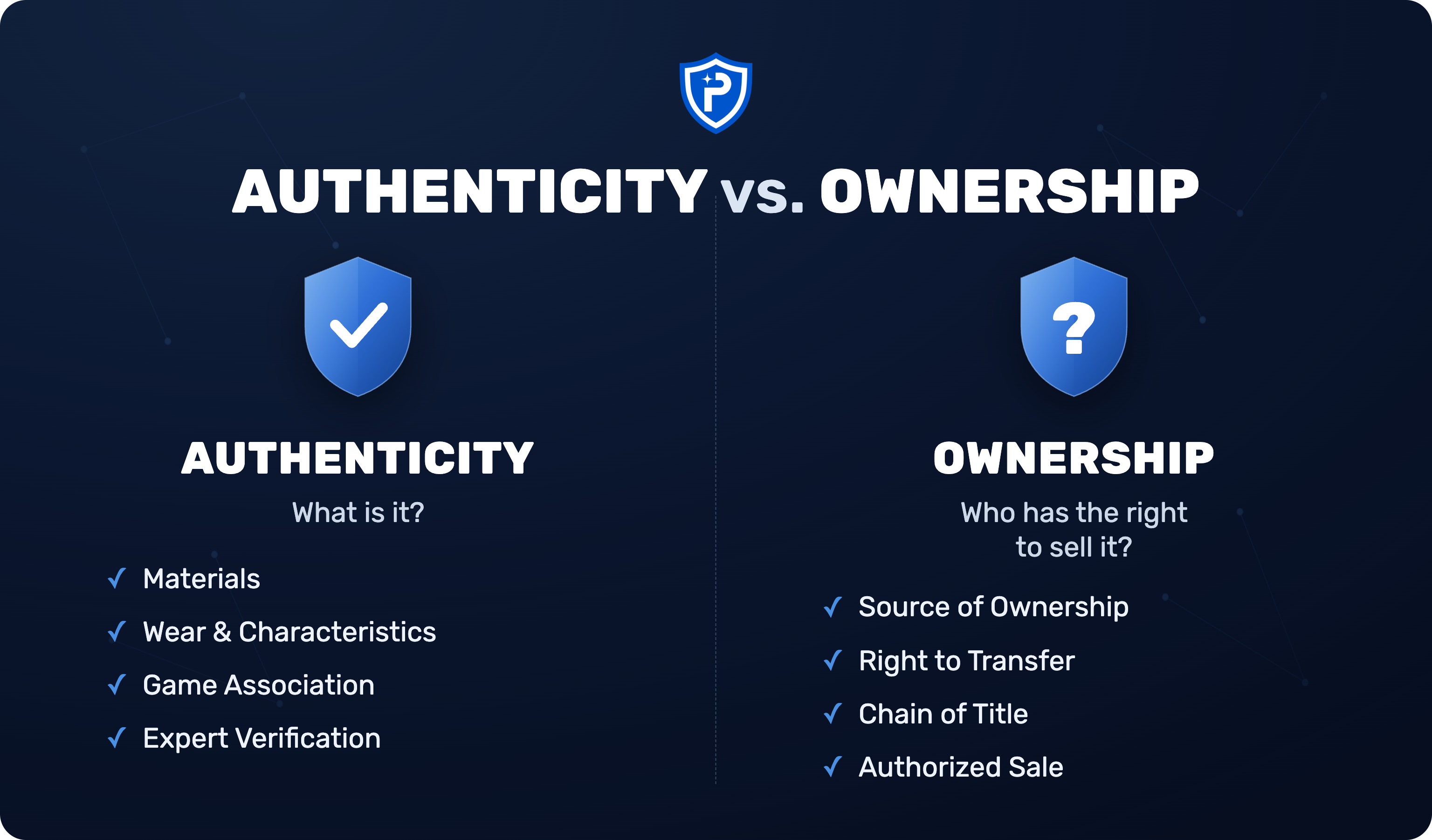
Authentication and ownership answer two fundamentally different questions.
Authentication asks: Is this what the seller says it is?
It can establish characteristics of the physical object — whether the item is genuine, whether it was associated with a particular athlete or game, whether physical characteristics match known evidence, and whether expert analysis supports the item’s story.
Ownership asks: Does this person have the right to sell it?
That requires a different history.
How did the item leave the team, league, athlete, venue or other source? Was it sold? Gifted? Awarded? Released from inventory? Transferred to an authorized memorabilia partner? Did the organization intend for it to leave its possession at all?
An item can pass the first test while creating serious questions around the second.
That is why authenticity and ownership should complement each other rather than be treated as the same thing.
Recent Cases Show Why the Distinction Matters
A current dispute involving a pair of Kobe Bryant shoes provides a useful example.
In August 2026, a former Utah Jazz ball boy filed a lawsuit connected to a pair of shoes attributed to Kobe Bryant that sold at auction for $99,000. The dispute centers on ownership claims and allegations that uncertainty surrounding the shoes affected their auction value.
The interesting question is not simply whether the shoes are associated with Kobe Bryant.
It is whether there is a sufficiently clear ownership history behind them.
A similar issue emerged around artifacts connected to one of the most famous moments in baseball history: Hank Aaron’s 715th home run.
The Atlanta Braves became involved in a legal dispute over the home plate and bases from the historic 1974 game. The dispute was not primarily about whether the bases were authentic. It centered on who actually owned them and whether they had been removed without authorization. In May 2026, the dispute concluded with the memorabilia being returned to the Braves.
Then there is an even more striking example from the NBA.
Federal prosecutors said a former Miami Heat security employee stole more than 400 game-worn jerseys and other memorabilia from a secured equipment room. More than 100 of those items were sold. One game-worn LeBron James Miami Heat NBA Finals jersey was sold for approximately $100,000 and later sold at auction for $3.7 million.
The jersey did not become fake because it was allegedly stolen.
It could still be genuinely game-worn.
The problem was its path into the market.
These are very different cases, and they should not be treated as identical. But together they highlight an important distinction for the memorabilia industry:
Authenticity can establish what an item is. It does not necessarily establish who had the right to sell it.
When Does Team Property Become Collector Property?
This leads to a surprisingly complicated question.
When does a piece of sports equipment become privately owned memorabilia?
Consider a jersey issued by a professional team.
It begins as organizational inventory. The jersey is assigned to a player and worn during a game. Afterward, it may return to an equipment room, remain with the athlete, be designated for an auction, go to a memorabilia partner, be gifted to someone, or eventually enter a private collection.
At some point, custody changes.
But did ownership change at the same time?
Now consider player-worn shoes. If an athlete hands them directly to a fan, staff member or ball boy, is that a transfer of ownership? In many situations it may be. But what if the item technically belonged to the team, sponsor or another organization?
What if an employee removes a jersey from storage? Physical possession has changed, but ownership has not necessarily changed with it.
These questions can seem operational when the item has little monetary value.
They become considerably more important when that same item is eventually worth $100,000, $1 million or several million dollars.
The market often discovers the ownership question only after the value has already been created.
Possession Is Not Provenance
Simply possessing an item does not explain how it was obtained.
A marketplace listing does not establish ownership.
A certificate of authenticity does not necessarily establish ownership.
Even a receipt from a previous seller only tells the next buyer who sold it to them. It does not automatically establish whether every earlier owner had the right to transfer the item.
This is where provenance becomes more than a record of authenticity.
A complete provenance record should help establish the authorized lifecycle of the asset.
Where did it originate?
When did it leave the source?
Who was the first legitimate owner?
How was it transferred?
Who owns it now?
Those events create something closer to a chain of title.
The First Ownership Event May Be the Most Important

For teams and rights holders, the most important ownership event may not be the second or third resale.
It may be the first one.
There should be a clear point where an item moves from organizational custody into private ownership.
Imagine a game-used jersey that begins inside team inventory. It is identified and associated with the player and game. After the game, the organization decides the item will enter its official memorabilia program.
The team releases the item.
A buyer purchases it.
The buyer claims it.
At that moment, there is a clear transition:
Team Inventory → Authorized Release → First Owner
That first transfer creates the foundation for everything that follows.
If the owner later sells the jersey, ownership can transfer again. If the next collector resells it years later, another ownership event can be recorded.
Instead of trying to reconstruct the ownership story after several transactions, the history starts with the organization that originally controlled the item.
Digital Deeds Can Become More Than Certificates
This is where the concept of a digital deed becomes particularly interesting.
A digital deed should not simply be another digital certificate saying an item is authentic.
Its larger value is the ability to create a living record around the asset.
The item originates with the source. Its identity and history are established. The source authorizes its release. The first owner claims it. Future transfers are recorded as the asset changes hands.
The digital deed evolves with the item.
This does not mean a digital record replaces legal ownership rules, contracts or expert authentication. It should not pretend to.
Instead, it provides something the memorabilia market often lacks today: a structured record showing how the asset moved from its source into the hands of collectors.
That is a much stronger foundation for trust.
Think About a Collectible More Like a Titled Asset
High-value assets in other markets already separate identification from ownership.
A vehicle has a VIN that identifies the vehicle, but it also has a title that establishes ownership.
A property has a physical address and legal description, but it also has a deed and recorded ownership history.
Fine art collectors place enormous value on provenance because the history of ownership can affect authenticity, legality and value.
Sports memorabilia increasingly deserves similar thinking.
A unique identifier can help establish which physical item we are discussing.
Authentication can help establish what that item is.
Provenance can establish its history.
And a documented ownership trail can help establish how the current owner came to possess it.
Those layers work together.
The future of high-value sports collectibles should not depend on any one of them alone.
Teams and Rights Holders Are in a Unique Position
The organization closest to the origin of an item has something the secondary market can never fully recreate later: knowledge of the first legitimate transfer.
A team knows whether a jersey came from its inventory.
A league can know whether an item came from an official event.
An athlete or authorized partner may know when an item was legitimately gifted or released.
An official memorabilia program knows when an item was intentionally placed into commerce.
That information becomes extremely valuable later.
Instead of forcing an auction house, collector or authenticator to reconstruct the beginning of the story years afterward, the source can establish the first ownership record when the item actually enters the market.
This is not about teams controlling what collectors do with their property.
Once ownership has legitimately transferred, the collector should be able to own, hold, gift, transfer or sell the item subject to applicable agreements and laws.
The opportunity for the team is different.
Establish the beginning of the story clearly.
A Better Lifecycle for Sports Memorabilia
The industry already has many of the individual pieces needed to create a more trusted memorabilia ecosystem.
Teams have inventory systems.
Authenticators have expertise.
Photomatching services have visual evidence.
Marketplaces facilitate transactions.
Collectors create demand.
What is missing is a consistent layer connecting the asset across those different stages.
A more complete lifecycle could look like this:
Source → Item Identity → Game/Event Association → Authorized Release → First Owner → Transfer → Resale
Authentication can be attached to that history.
Photomatching can be attached to it.
Images, videos and event information can become part of it.
Ownership changes can extend it.
The result is not simply a certificate.
It is an evolving asset history.
The Next Trust Question Is “Who Owns It?”
For decades, sports memorabilia has focused heavily on answering:
Is it real?
That question will always matter.
But as individual collectibles reach six-, seven- and even eight-figure valuations, another question becomes increasingly important:
Is the ownership real?
A genuinely game-worn jersey with an uncertain ownership history still carries risk.
A photomatched item without a clear path out of team custody still leaves questions.
An authentic artifact involved in an ownership dispute can still create uncertainty for collectors, marketplaces, teams and rights holders.
The next evolution of sports memorabilia trust should bring those questions together.
Authenticate the object.
Record the moment.
Document the authorized release.
Establish the first owner.
Record future transfers.
Then let the provenance travel with the asset.
Because proving what an item is should only be the beginning.
The strongest memorabilia market will be one that can prove both the story of the item and the story of its ownership.