

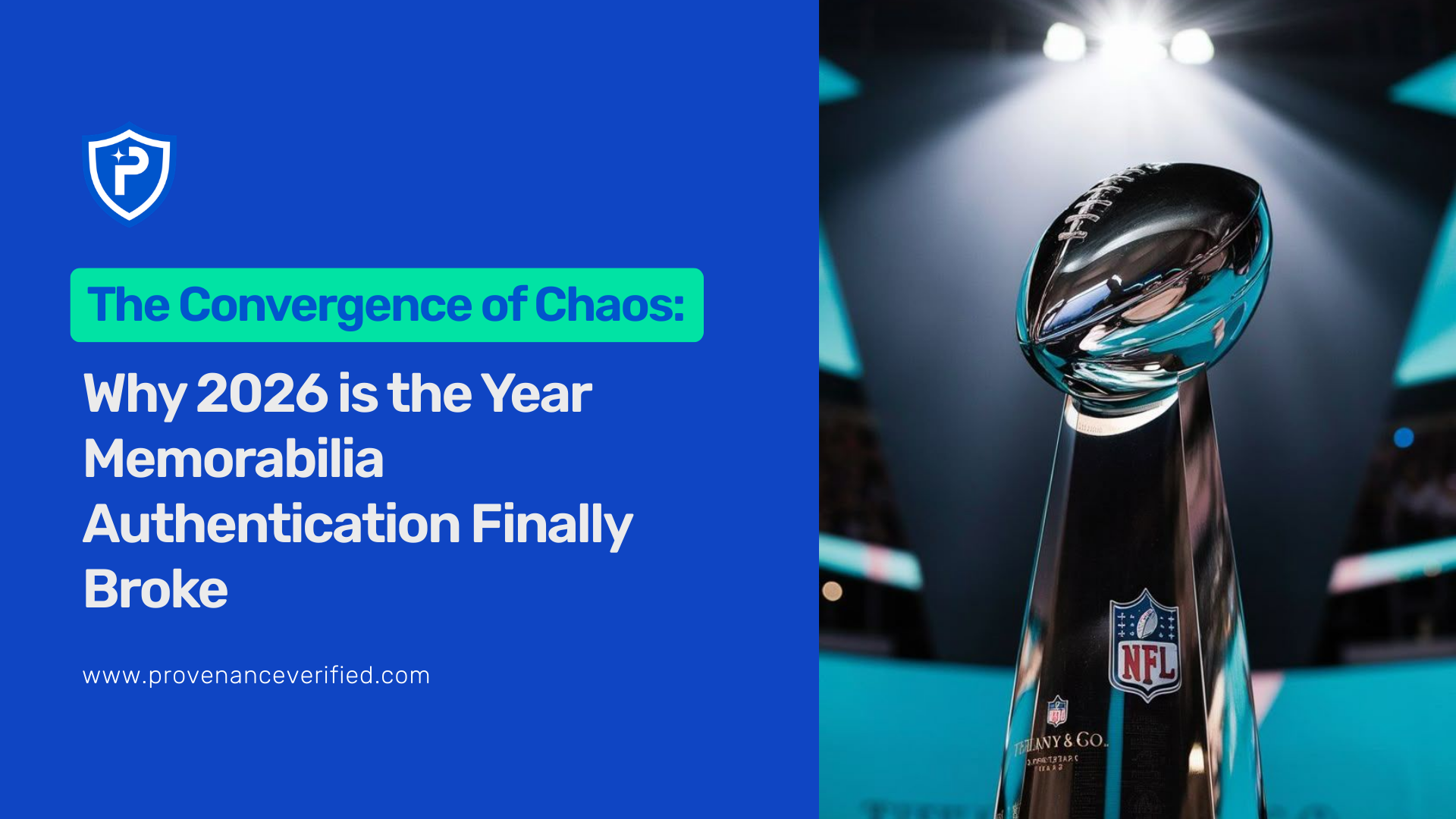
Why 2026 Is the Year Memorabilia Authentication Finally Broke
It’s only February — but something fundamental has already broken.
In just a few weeks, the sports memorabilia industry experienced a wave of fraud that spanned the full spectrum of the market. Counterfeit Super Bowl merchandise moved through sophisticated online storefronts. High-value collectibles were manipulated inside “secure” cases. And the systems meant to prove authenticity were themselves exposed as forgeable.
These aren’t isolated incidents. Together, they reveal a structural failure in how authenticity is established and protected — one that stickers, slabs, and certificates were never designed to withstand.
For fans, this creates confusion.
For teams, it creates risk.
For collectors, it creates doubt.
This is the Convergence of Chaos.
Super Bowl Counterfeits and the Illusion of “Official”
In the days surrounding Super Bowl LX, federal authorities announced the seizure of more than 276,000 counterfeit sports items valued at $33.4 million. Jerseys, hats, and novelty merchandise were intercepted after being sold through polished e-commerce sites that closely mimicked official team stores.
This wasn’t a parking-lot problem. It was a digital one.
Counterfeiters leveraged:
-
- Sophisticated online storefronts
-
- Paid social media advertising
-
- Branded language and imagery designed to look “official”
To most fans, these products appeared legitimate. Logos were correct. Photography was professional. The word official was everywhere.
And that’s the point.
When counterfeit merchandise can be distributed digitally, at scale, with near-perfect visual fidelity, labels and licensing language stop being meaningful defenses. By the time enforcement intervenes, transactions have already occurred — and trust has already been eroded.
What’s missing isn’t effort or enforcement.
It’s a verifiable link between an item and its origin.
When “Secure” Collectibles Aren’t Secure
At the other end of the market, a different vulnerability was exposed.
In late January, a Manhattan jury convicted Anthony Curcio for a scheme that targeted graded collectibles — long considered one of the safest categories in the hobby.
The fraud didn’t rely on fake cards. It relied on compromised containers.
Using readily available tools, tamper-resistant cases were opened, legitimate labels were removed, and higher grades were substituted. Once resealed, ordinary items re-entered the market as premium collectibles, commanding prices that bore no relation to reality.
The implication is uncomfortable but unavoidable:
Plastic protects condition.
It does not guarantee identity.
If value depends on what an item claims to be — rather than what can be independently verified over time — even the most trusted housing becomes a single point of failure.
When the Proof Is as Fake as the Item
The most damaging revelations weren’t technical. They were systemic.
Investigations into large-scale memorabilia fraud revealed cases where counterfeit holograms and certificates were produced to visually replicate those used by well-known authenticators. Buyers weren’t just misled by fake items — they were misled by fake proof.
When a sticker, certificate, or hologram can be manufactured as easily as the autograph or jersey it accompanies, post-sale authentication collapses entirely.
At that point, the system isn’t failing at the edges.
It’s failing at the center.
The Common Failure: Authentication Happens Too Late
These stories unfolded in different corners of the market, but they share the same flaw.
Traditional authentication asks a question after value has already been created:
Does this look real?
Stickers, slabs, and certificates are opinions applied downstream. They attempt to infer truth rather than establish it. That approach only works when fraud is small, tools are unsophisticated, and trust hasn’t been industrialized against itself.
None of those conditions exist in 2026.
Why Provenance Is a Different Model

Provenance isn’t a better sticker. It’s infrastructure.
Instead of verifying items after the fact, provenance records facts at the moment value is created and carries those facts forward for the life of the item.
With Provenance Verified, each verified collectible:
-
- Is embedded with a secure NFC identifier
-
- Is linked to a blockchain-backed digital certificate
-
- Has its origin, ownership, and transfers recorded over time
-
- Can be verified instantly with a simple tap — no expert required
Rather than asking whether something looks authentic, fans and collectors can see where it came from, when it was created, and how it moved.
Authentication reacts.
Provenance records reality.
Why This Matters Now
The Super Bowl draws global attention — and global scrutiny.
As counterfeit merchandise floods digital channels and high-value collectibles are manipulated with everyday tools, the industry is being forced to confront a hard truth:
Trust can no longer be outsourced.
Owning the chain of custody — from creation to resale — isn’t a nice-to-have. It’s the only sustainable defense against fraud that now moves faster than traditional systems can respond.
The Bottom Line
It’s only February. But the pattern is already clear.
In 2026:
-
- “Official” is no longer enough
-
- Stickers can be forged
-
- Slabs can be cracked
-
- Certificates can be copied
The future of sports memorabilia doesn’t belong to better opinions.
It belongs to verifiable history.
That’s what Provenance Verified was built for.
Learn more — and join the waitlist — at ProvenanceVerified.com.