


In July 2025, the sports collectibles market reached a breaking point. Brett Lemieux, operating under the “Mister Mancave” name, admitted to selling hundreds of millions of dollars in forged autographs and memorabilia over nearly two decades. Many of these items carried “verified” holograms and were associated with legitimate authentication databases.
For collectors, the scandal exposed widespread fraud.
For professional teams and merchandise operators, it exposed something more serious: a structural failure in how provenance is created, tracked, and defended.
The issue was not simply fake items.
It was the absence of a verifiable chain of custody tying real items back to an authoritative source.
The Anatomy of a Systemic Failure
The Mancave operation did not rely on crude counterfeits. It exploited a weakness embedded in traditional authentication systems.
Signatures were forged, but so was the verification layer itself. Physical holograms were replicated. Database lookups confirmed that serial numbers existed, not that the physical item being inspected was the one originally issued. Once items left controlled environments, there was no durable way to prove origin, custody, or legitimacy.
At scale, trust replaced proof.
Operator takeaway: Authentication without custody verification creates a single point of failure.
Why Holograms and COAs No Longer Hold Up
For decades, sports memorabilia relied on visual authentication: stickers, certificates of authenticity, and serial numbers tied to centralized databases. That model assumed physical markers could not be convincingly reproduced.
That assumption no longer holds.
Modern fabrication tools can replicate holograms with high fidelity. Static databases confirm records, not objects. They cannot prevent substitution, replay, or misrepresentation once an item changes hands.
Operator takeaway: Visual authentication breaks down as volume, value, and time increase.
From Authentication to Provenance Infrastructure
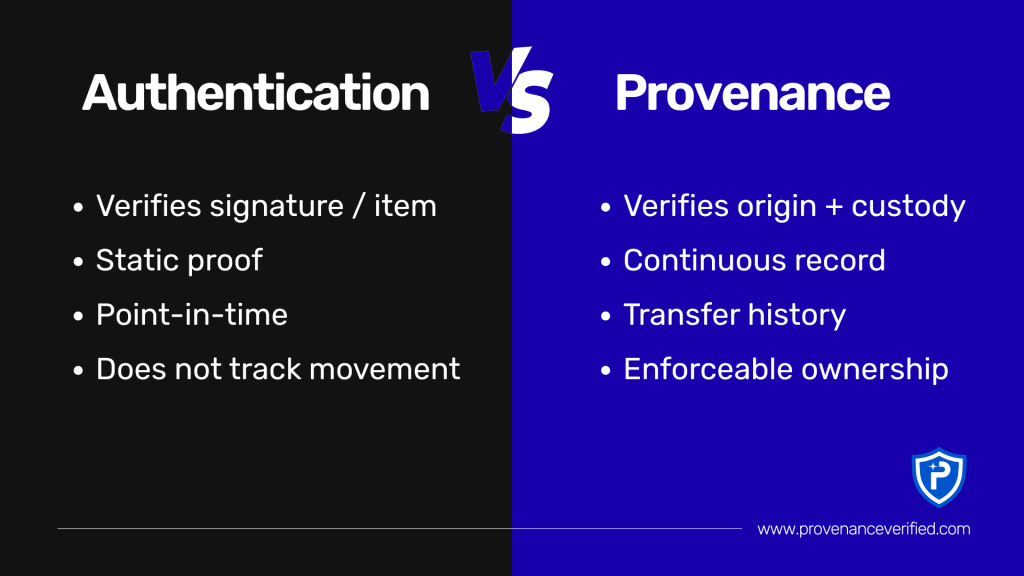
What the market now requires is not better inspection, but verifiable provenance.
Chain of custody must begin at the source—when an item leaves a locker room, equipment room, or field of play—and persist through every transfer: storage, sale, resale, and ownership change. This “locker-to-ledger” model replaces reputation and paperwork with auditable history.
For teams, this is not fan technology.
It is internal control infrastructure.
Operator takeaway: Provenance is an operational system, not a marketing feature.
Why High-Value Items Change the Rules
As milestone and one-of-one items reach seven-figure valuations, informal processes become liabilities. High-net-worth buyers, insurers, and auction houses increasingly demand independently verifiable custody records before capital moves.
Teams are no longer selling memorabilia alone.
They are selling certainty.
The New Standard for Sports Merchandise Operations
In the post-2025 market, trust is insufficient. Proof must be durable, transferable, and independently verifiable.
If someone else can credibly claim your inventory, you do not control it.
Certainty is now the product—and provenance is the system that delivers it.