

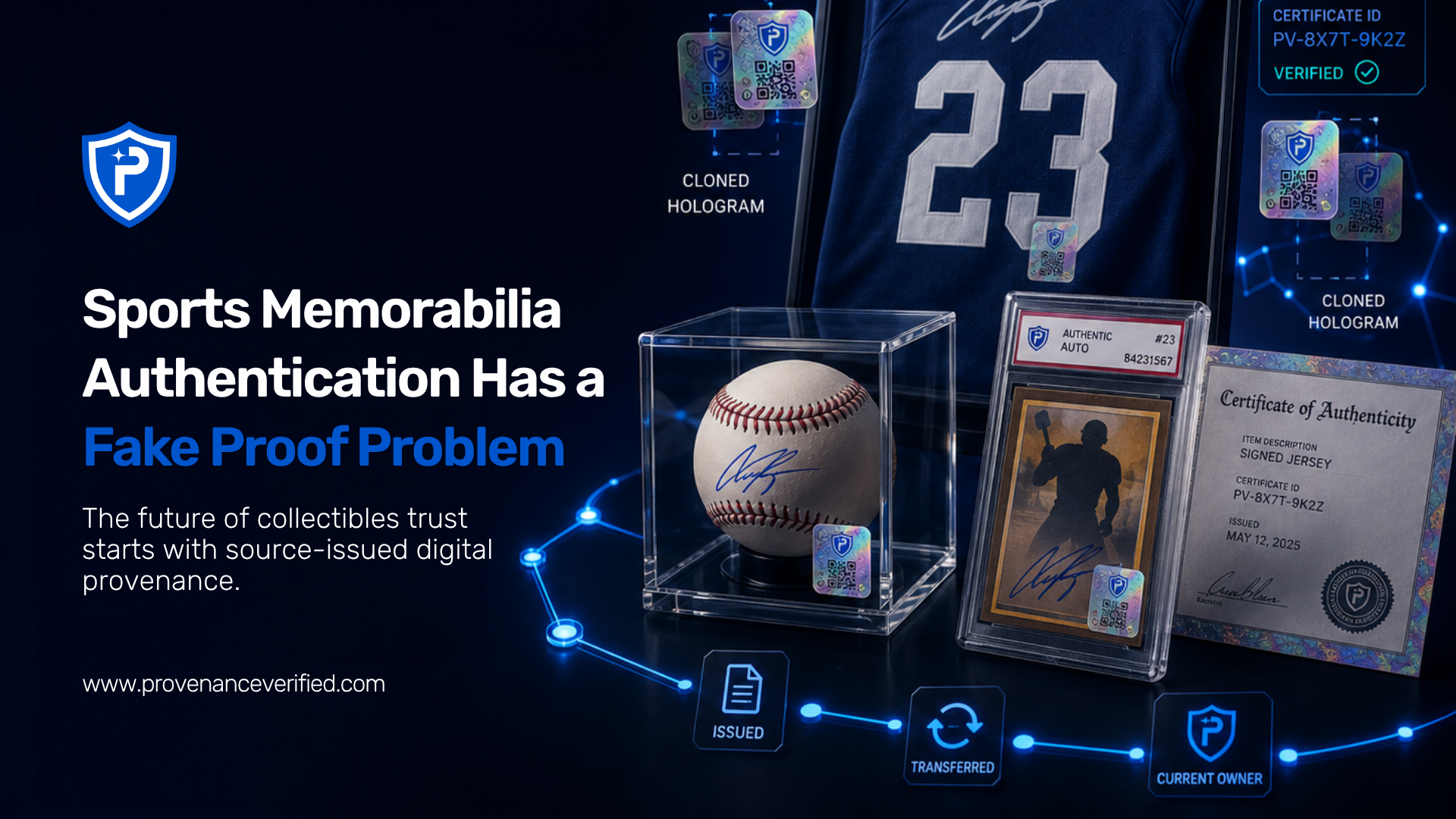
Why the future of collectibles trust starts with source-issued digital provenance
The sports memorabilia market does not just need better authentication.
It needs source-issued proof that stays connected to the item.
That means a digital provenance record that begins with the team, league, venue, athlete, event, or authorized partner — and continues as the item is claimed, transferred, resold, or passed to the next owner.
That is the part the industry has not fully solved.
For years, the market has relied on certificates of authenticity, holograms, stickers, grading labels, serial numbers, and database lookups. These tools helped clean up a market that used to rely too much on reputation, handwritten stories, and “trust me” selling.
They gave buyers more confidence.
They helped marketplaces scale.
They made sports collectibles feel more like investable assets.
But the weakness is now obvious.
The proof is often separate from the item. And once the market learns to trust a piece of proof, that proof becomes valuable enough to copy.
A fake autograph is one problem.
A fake autograph with a believable COA, matching serial number, copied hologram, or familiar-looking authentication sticker is a much bigger problem.
At that point, the buyer is not just trusting the item.
The buyer is trusting the entire proof system around it.
That is where the market is breaking.
The Problem Is Not Just Fake Memorabilia
Most people still think of collectibles fraud as someone forging a signature, altering a card, or selling a fake game-used item.
That still happens, and it still matters.
But the bigger risk is now one layer deeper.
The memorabilia market has a fake proof problem.
That is why recent fraud stories around the category matter. They are not just stories about bad sellers or counterfeit items. They show a larger issue: the trust signals buyers depend on can be copied, separated from the item, reused, or shown out of context.
The market has trained buyers to look for those signals.
Check the COA.
Look for the sticker.
Confirm the serial number.
Search the database.
Trust the label.
Then buy with confidence.
But what happens when those same signals are no longer enough?
That is the uncomfortable question facing teams, leagues, venues, rights holders, collectors, authenticators, and marketplaces.

Static Proof Helped the Market Grow, But It Cannot Carry the Market Alone
Certificates, holograms, labels, and serial numbers are not the enemy.
They serve a real purpose, and reputable authenticators will continue to matter.
The problem is that static proof was never designed to carry the full history of an item.
A COA may say an item was reviewed at one point in time, but it does not always prove the item in front of the buyer is the same item.
A hologram may be attached to a jersey, but the buyer still has to trust that the hologram is real.
A serial number may appear in a database, but a database lookup does not always explain custody, ownership, transfer history, or whether the proof still belongs to the physical object.
That is too much work for the buyer and too much room for bad actors.
This is where sports memorabilia is different from normal merchandise.
A shirt sold in a team store is worth what someone paid for it. A game-used jersey, signed helmet, championship item, or player-issued collectible can increase in value because of the story attached to it.
The object matters.
But the story creates the premium.
If the story cannot be trusted, the premium starts to collapse.
The First Record of Truth Should Come From the Source

The strongest authenticity signal should come from the organization closest to the item’s origin.
That could be the team, league, venue, athlete, event, authorized retail operator, or licensed partner.
That first record should not be created after the item has already moved through the market. It should be created when the item is issued, sold, claimed, or transferred for the first time.
This is the shift the industry needs to make.
Instead of asking the market to reconstruct the story later, the source should create the story at the beginning.
That first record should answer the questions buyers actually care about:
What is this item?
Where did it come from?
Who issued it?
When did it enter the market?
Who claimed it first?
Who owns it now?
Has it been transferred?
Is it eligible for resale?
Is the proof still connected to the physical object?
That is not just authentication.
That is provenance.
A Certificate Is Not the Same as a Chain of Title
A certificate tells you something about a moment.
Provenance tells you the history of the item.
That difference matters more as sports collectibles become more valuable, more liquid, and more important to fans.
A signed ball is not just ink.
A game-used jersey is not just fabric.
A championship item is not just merchandise.
These objects carry the value of the team, the athlete, the event, and the moment.
That value should not depend only on a disconnected piece of paper, sticker, label, or serial number.
A stronger model gives the item a connected record.
The source issues the item.
The physical object is linked to a digital deed.
The fan claims ownership.
Future transfers are recorded.
The history stays with the item instead of sitting beside it.
That does not replace authentication.
It strengthens it.
Expert review, witnessed signings, physical identifiers, grading, and certificates can still matter. But they should be part of a broader trust system, not the entire system.
Why This Matters to Teams and Rights Holders
For teams, leagues, venues, and rights holders, this is not just a collector protection issue.
It is a brand control issue.
It is a fan trust issue.
It is a revenue lifecycle issue.
The team creates the moment.
The athlete creates the meaning.
The venue creates the context.
The league creates the platform.
The fan creates the demand.
But after the first sale, the asset often moves into a market where the rights holder has little visibility and even less control.
That does not make sense.
If a team issues a game-used item, limited-edition collectible, signed piece, or event-specific drop, the team should be able to stay connected to the item’s history.
Not to control every fan interaction, but to protect the integrity of the asset and the market around it.
Source-issued provenance gives teams and rights holders a way to do that.
It helps protect official inventory, supports trusted resale, gives fans more confidence, and creates a foundation for long-term participation in the value of the category.
This is bigger than selling more memorabilia.
It is about owning the trust layer around official sports collectibles.
Fans Should Not Have to Investigate the Item
The current market asks too much of fans.
A fan has to know which authenticator matters.
They have to decide whether a COA looks right.
They have to trust that a hologram is legitimate.
They have to check whether a serial number matches.
They have to decide whether a seller is credible.
They have to figure out whether the proof actually belongs to the item being sold.
That may work for experienced collectors.
It does not work for the broader fan market.
If teams and leagues want memorabilia to become a larger and more trusted commerce category, the experience has to become simpler.
A fan should be able to scan or tap the item and see a clean record showing:
Where it came from.
Who issued it.
Whether it is connected to the physical item.
Who owns it.
How it moved.
The fan should not have to become a forensic investigator.
The infrastructure should do that work.
The Future Is Verified Asset History
The memorabilia market is moving from authenticated objects to verified asset history.
That is the real shift.
The old model was built around one question:
Is this item real?
The next model needs to answer a better set of questions:
Where did this item come from?
Who issued it?
Who claimed it?
Who owns it now?
How did it move?
Can the story be proven?
That is where digital deeds and source-issued provenance matter.
They create a record that begins with the source and stays connected to the item as it moves through claim, ownership, transfer, and resale.
The market does not need more disconnected proof.
It needs proof that is harder to separate from the item, harder to fake, and easier for the buyer to understand.
That starts with the source.
For teams, venues, leagues, and rights holders, the opportunity is clear:
Own the first record.
Own the chain of title.
Own the trust layer around the moments fans care about most.
Because the future of sports memorabilia will not be defined only by who can authenticate an item after the fact.
It will be defined by who can prove the story from the beginning.