


In sports memorabilia, everyone talks about authenticity.
Very few talk about movement — the actual chain of custody that tracks how a game-used or team-issued item travels from the locker room to retail to a fan and eventually into the secondary market.
And that is the real problem.
Most teams have no complete, verifiable chain of custody for their memorabilia. Game-worn jerseys, sticks, helmets, gloves, footballs, and other assets pass through several operational handoffs. Each one introduces uncertainty, risk, and lost value.
Research shows this gap is one of the biggest structural vulnerabilities in the sports collectibles market.
This is the gap Provenance closes.
But first, we need to be honest about how memorabilia operations work today.
Where the Chain Breaks
Teams focus on the item. Collectors focus on the signature or certificate. But the true value is the verified record of how that item traveled.
Today, that record is missing.
1. Locker Room to Equipment Manager
This is where the story begins. And this is where the chain of custody is usually broken.
Most teams rely on handwritten notes, spreadsheets, photos saved on a phone, or memory. There is no real-time item identity, no timestamp, and no unified log.
If this step is incomplete, everything after it rests on uncertainty.
2. Internal Hand-Off to Retail or Authenticator
Game-used vs game-issued vs team-issued determines value.
This classification often depends on manual tagging and communication. If anything is mislabeled at this stage, the provenance is compromised.
3. Retail Floor to Fan
Once an item is sold, the team’s visibility stops. There is no persistent digital identity that follows the item into the world.
Fans rely on screenshots or receipts. That is not provenance.
4. Fan to Secondary Market
This is where the industry loses trust and value.
Marketplaces cannot verify most team-issued metadata. Buyers cannot trace game-used items back to the arena. Authenticators rely on opinion.
Studies estimate that half or more of autographed items on the secondary market have questionable provenance.
No chain of custody means no trust. No trust means limited value.
Why Teams Are Paying Attention
The chain-of-custody gap is now a direct operational and commercial issue.
Teams lose revenue when resale happens outside their ecosystem. Teams lose trust when fans doubt what they are buying. Teams lose control when marketplaces set value. Teams lose speed because authentication workflows are slow and manual.
The market is projected to reach more than forty billion dollars by 2030. But the lack of custody infrastructure suppresses real value.
Everyone knows the system is broken. No one has had a way to fix it.
Until now.
Provenance Solves the Chain-of-Custody Problem at the Source
Provenance is not another certificate, sticker, or hologram.
It is an end-to-end digital provenance system.
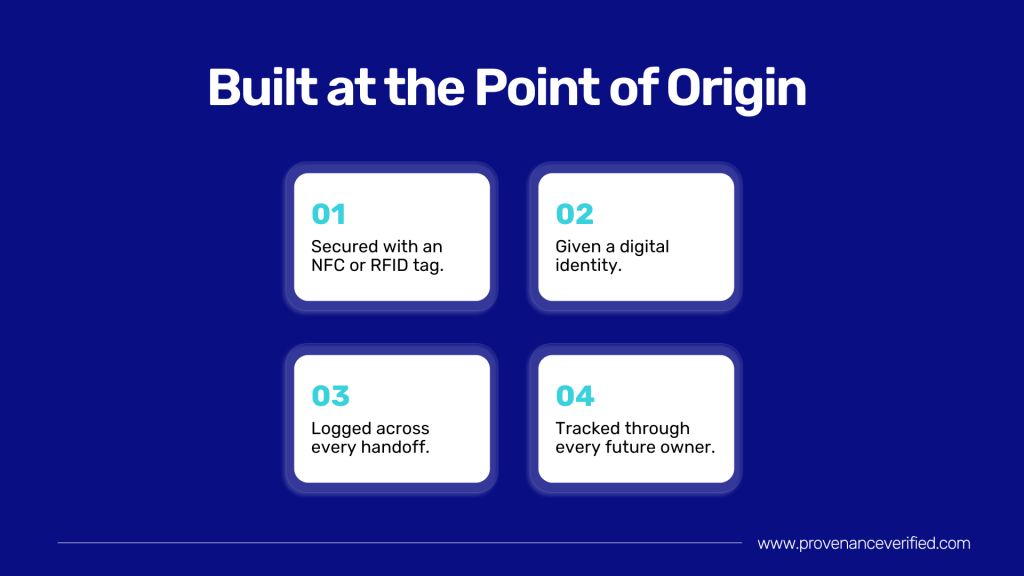
When a game-used or team-issued item leaves the locker room, it is:
- Secured with an NFC or RFID tag.
- Given a digital identity.
- Logged across every handoff.
- Tracked through every future owner.
Teams get real-time tracking, verified game-used status, and a unified authenticity and resale system. Fans and collectors get transparent history, instant verification, and confidence.
This is what complete provenance looks like.
The Result: Trust You Can See, Share, and Sell
With a complete chain of custody, teams do not just sell items. They sell structured stories backed by verifiable truth.
Teams gain new lifetime revenue, counterfeit protection, and full control of asset identity. Collectors gain proof, transferability, and confidence. Leagues gain transparency and compliance.
For the first time, the market gets a standardized, tamper-proof, team-backed record of truth.
This Is the Future of Authentic Collectibles
The next era of memorabilia will not rely on certificates, stickers, or subjective photo-matching.
It will rely on digital custody captured at the moment of origin and preserved through every owner.
This is the infrastructure the industry has been missing. This is what Provenance delivers.
Authenticity matters. But without a chain of custody, authenticity has nothing to stand on.
How Teams Authenticate Game-Used and Team-Issued Items Today
Teams often search for terms like how to authenticate game-used memorabilia or how to track game-worn jerseys. Most current systems rely on manual logging, paper certificates, stickers, and human interpretation.
These methods do not provide a secure chain of custody and do not create a digital record that follows the item for its entire life.
A modern sports memorabilia authentication system needs:
- Digital locker room logging
- Secure NFC or RFID tagging
- A provenance tracking platform
- A digital chain of custody for collectibles
- A real-time record that teams, fans, and collectors can verify instantly
Provenance delivers this complete system.
Common Search Questions From Teams
Teams and operators frequently ask:
- What is the chain-of-custody system for game-used items
- How do teams authenticate game-worn memorabilia
- What is the best way to track team-issued gear
- How do we stop counterfeit memorabilia
- How do you build a provenance record for collectibles
This article now answers these questions directly and in simple terms.
Glossary of Key Terms
Game-Used: An item worn or used by a player in an official game.
Game-Issued: An item prepared for a player that may not have been used in a game.
Team-Issued: An item produced for team operations but not tied to a specific game.
Digital Chain of Custody: A digital, verifiable record of every handoff, transfer, and ownership event for a physical item.
Provenance Tracking Platform: A system that logs where an item came from, who handled it, and how it moved through its lifecycle.